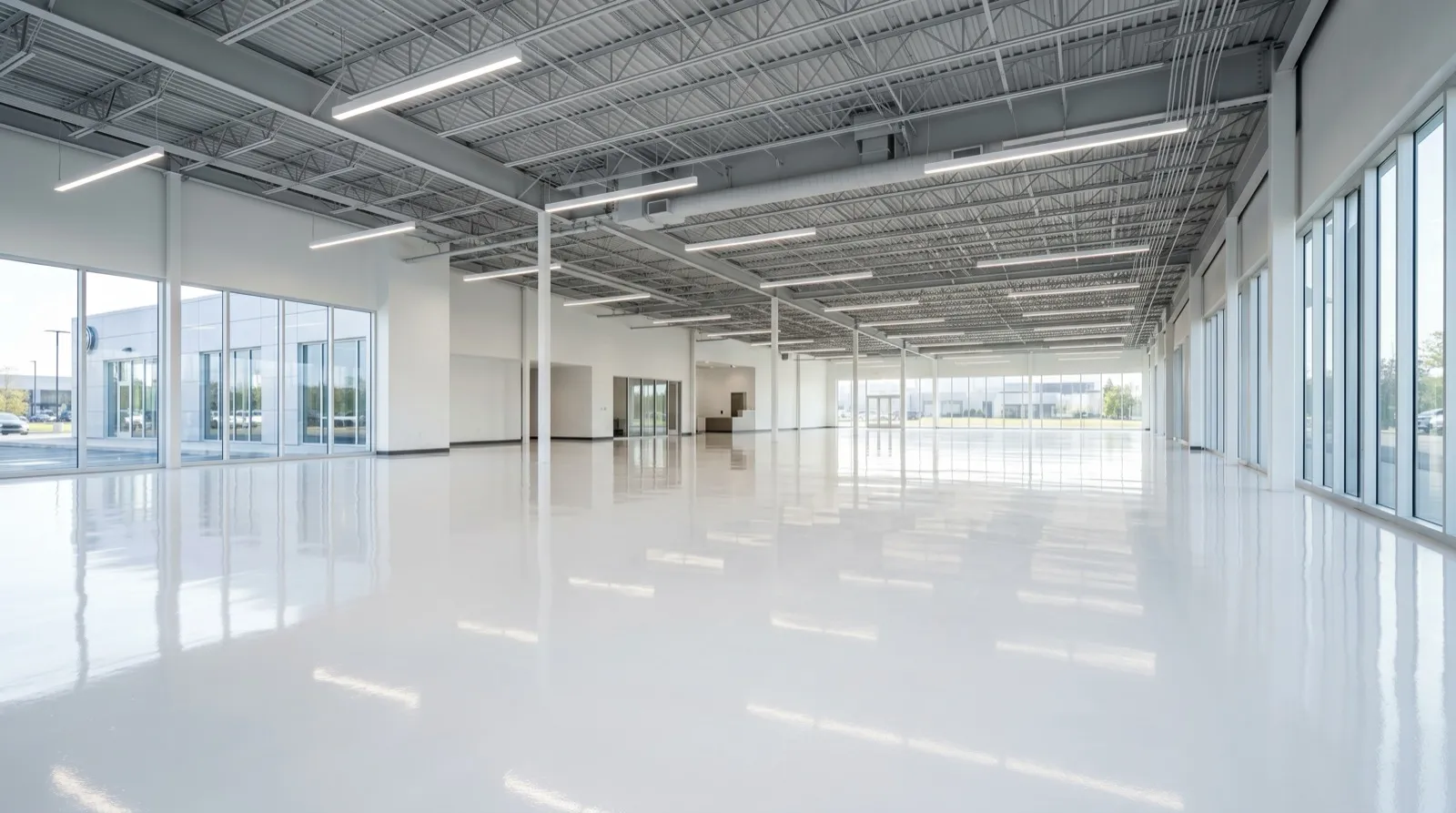
OSHA-compliant commercial floor coatings in Rapid City require four things: a coefficient of friction above 0.5 wet, embedded safety striping in OSHA-approved colors, a chemical-resistant topcoat rated for your specific spill profile, and enough system thickness to handle your traffic load. Skip any of those and you are either failing an OSHA walkthrough or replacing your floor inside three years. Here is the full spec for Rapid City businesses.
The four pillars of an OSHA-compliant floor
1. Slip resistance (coefficient of friction)
OSHA 1910.22 requires walking-working surfaces to be "kept in a clean, orderly, and sanitary condition" and free of slip hazards. The practical industry standard is a static coefficient of friction (SCOF) of 0.5 or higher when wet. A smooth-troweled epoxy floor by itself comes in around 0.3 SCOF, which is enough to trigger a citation.
We hit the 0.5 SCOF threshold by broadcasting an anti-slip aggregate into the wet topcoat. Two options:
- Aluminum oxide at 50 to 80 mesh. Aggressive grip. Right for warehouse main lanes, dock plates, and ramps where forklifts and foot traffic mix.
- Silica or polypropylene at 80 to 150 mesh. Moderate grip. Right for showroom floors, retail aisles, and food prep where the surface needs to be cleanable.
For a Rapid City auto service bay or a small manufacturing shop, we typically default to aluminum oxide at 60 mesh. For a brewery taproom or a dealership showroom, we step down to silica at 100 mesh.
2. Embedded safety striping
OSHA does not require specific colors but ANSI Z535.1 (which OSHA references) does. The standard color codes:
| Color | Meaning | | --- | --- | | Safety yellow | Caution, physical hazard zone | | Safety red | Fire equipment, emergency stop | | Safety green | First aid, safety equipment | | Safety blue | Information, equipment status | | White | Walking pathways, aisles | | Orange | Dangerous parts of machines |
Paint stripes get worn off by forklift tires in 6 to 12 months in a working warehouse. We embed the striping into the resin during install, which means the stripes last as long as the floor. Same diamond grind on the stripe lanes, same base coat, same topcoat. The striping is part of the floor, not on top of it.
3. Chemical-resistant topcoat
Different operations spill different things. The topcoat has to be matched to the actual chemical exposure profile of the space:
| Operation Type | Common Spills | Recommended Topcoat | | --- | --- | --- | | Auto service bay | Motor oil, brake fluid, antifreeze, gasoline | Polyaspartic | | Light manufacturing | Cutting oils, mild solvents, degreasers | Polyaspartic or polyurethane | | Food prep / brewery | Organic acids, fats, sanitizers | Polyurethane (food-grade) | | Aerospace / aviation | Hydraulic fluid, jet fuel, skydrol | Novolac epoxy + polyurea | | Chemical processing | Strong acids, bases, solvents | Vinyl ester or novolac epoxy |
For most Rapid City commercial work, polyaspartic handles the chemical profile. For aggressive industrial chemistry, we step up to novolac. We specify the right topcoat at quote time based on the actual chemicals in use, not a generic spec.
4. System thickness rated for load
A residential garage coating is 25 to 30 mils thick (about a credit card). That is fine for cars. It is not fine for a forklift.
Our commercial systems run 30 to 60 mils depending on traffic load:
- 30 mil for light retail, showroom, and walk-in commercial. Pedestrian traffic and light wheeled loads only.
- 45 mil for warehouse, service bay, and light manufacturing. Forklift-rated up to 3,000 PSI compressive strength.
- 60 mil for heavy industrial, dock plates, and high-frequency forklift lanes. Rated up to 5,000 PSI compressive strength.
- Urethane cement at 250 to 375 mil for the truly aggressive jobs: food processing with thermal shock, breweries with constant wash-downs, and dairies with organic acid exposure.
Food-grade versus industrial finishes
These get conflated and they should not. A food-grade floor needs to be antimicrobial, non-porous, USDA-compliant, and resistant to organic acids, sanitizers, fats, and thermal shock from steam cleaning. That almost always means polyurethane or urethane cement, not standard epoxy.
An industrial floor needs to be chemically resistant to oils, fuels, and solvents, but it does not need to be antimicrobial or USDA-compliant. Polyaspartic over a 100% solids epoxy build-out typically does the job at roughly half the cost of a true food-grade system.
If you are running a restaurant kitchen, brewery, or commissary in the Rapid City metro, ask specifically for food-grade urethane or urethane cement. If you are running a shop, warehouse, or auto service bay, polyaspartic over epoxy is the standard answer.
Working around operations: the night-shift question
Most of our commercial installs happen outside business hours. A typical 3,000 square foot warehouse floor can be done in 3 consecutive overnight shifts:
- Night 1: Diamond grinding to CSP-4, HEPA dust extraction, crack repair, control joint fill.
- Night 2: Moisture-mitigating primer if needed, then 100% solids epoxy base coat with anti-slip broadcast.
- Night 3: Embedded safety striping, chemical-resistant polyaspartic topcoat, final QC walk.
By the time your morning shift arrives, the floor is walkable. Forklift-ready 24 to 48 hours after the final coat depending on system. For businesses that cannot afford to lose a single operating day, this is the workflow.
Ellsworth AFB and government contractor work
We are insured for on-base work and have completed multiple contractor projects at Ellsworth. We can work within base access protocols, meet government specification requirements (UFGS, MIL-STD), and provide the documentation packages needed for federal contracts. If you are managing a hangar floor, vehicle bay, or supply facility on base, we can quote it.
The honest cost range
Commercial systems in Rapid City run $4.25 to $9.50 per square foot installed, depending on:
- System thickness (30, 45, or 60 mil).
- Anti-slip broadcast type and mesh size.
- Embedded safety striping linear footage.
- Slab prep complexity (grinding versus shot-blasting, moisture mitigation).
- Topcoat chemistry (polyaspartic, polyurethane, novolac).
A typical 3,000 square foot warehouse runs $12,000 to $18,000. A typical 1,500 square foot auto service bay runs $7,500 to $13,500. A typical 800 square foot showroom runs $4,500 to $7,500.
If your concrete is in rough shape, our standalone concrete crack repair workflow is sometimes the right starting point before we quote a full coating. We do not skip prep on commercial work, ever, because the load on a commercial floor will find every shortcut within the first quarter of operation.
Get a commercial site assessment
Free on-site assessment, slab moisture test, written scope, and flat quote within 48 hours. We work across the Rapid City metro, the I-90 corridor up to Sturgis, Spearfish, Belle Fourche, and the southern Black Hills down through Hot Springs.
Call (605) 555-0100 or request a commercial quote online. For more on prep specifically, see our prep-secrets guide which covers the same principles applied to residential work.