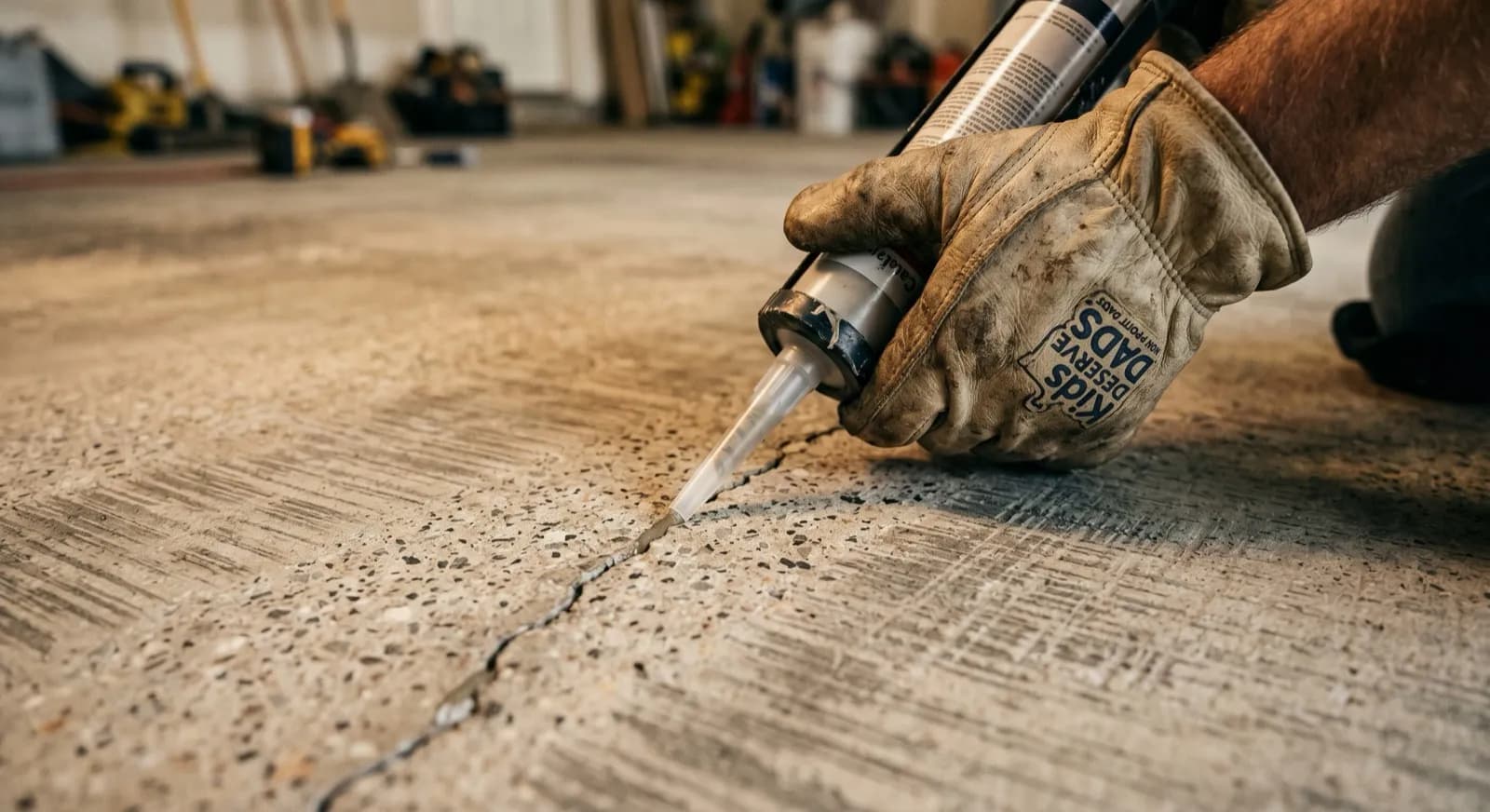
A Rapid City garage floor cracks every spring because water freezes inside the concrete and expands by 9% volume, pushing the slab apart from the inside. Each freeze-thaw cycle widens existing micro-fractures and creates new ones. By March, the damage is visible. Structural polyurea crack injection stops the cycle by sealing the slab against water entry and bonding the slab back together. Here is how the physics works and what real repair looks like.
The freeze-thaw physics, briefly
Concrete is porous. Water seeps into hairline cracks and capillary pores throughout the slab, especially during snow melt when the ground is saturated. When the temperature drops below 32°F, the water freezes and expands by roughly 9% volume. That expansion has to go somewhere. It pushes the surrounding concrete outward, widening the crack and breaking off small pieces of cement paste from the surface.
When the temperature rises back above freezing, the ice melts, the slab settles back, and more water seeps in. The next freeze event widens the crack further. Multiply that by the 120 freeze-thaw days per year we see in the Black Hills, multiply that by 10 years of unprotected concrete, and you have a slab that looks like the surface of the moon.
What you actually see in a Rapid City garage by April
The damage shows up in a predictable sequence:
- Year 1 to 2: Surface dusting where the cement paste starts to break free. The slab feels slightly chalky to the touch.
- Year 2 to 4: Hairline cracks open up, especially along the front edge near the garage door where snow melt pools.
- Year 4 to 7: Spalling begins. Quarter-inch deep chunks of concrete pop off at the corners and along the apron.
- Year 7 to 10: Structural cracks widen past 1/8 inch. Pitting reaches the aggregate layer.
- Year 10+: The slab has lost so much surface mass that it no longer serves as a clean, sealable floor. Coating it is no longer enough; structural repair becomes mandatory before any resin can go down.
Why DIY crack repair fails in under two years
The patch products you can buy at a big box store are essentially heavy caulk. They flex when the slab moves, which is good, but they have no structural value. They cannot bond the two sides of the crack back together. The next freeze-thaw cycle just pushes the patch out, or worse, traps water behind it.
We see this constantly when homeowners call us in for a follow-up. The DIY patch is sitting on top of the original crack like a strip of putty, the underlying crack has continued to widen, and now there are three or four new cracks branching off the original one. By the time we are routing it out, the structural damage is two to three times worse than if nothing had been done.
What structural polyurea injection actually does
Real crack repair is a three-step physical process:
- Rout out the crack with a diamond blade to expose sound concrete on both sides and create a V-shaped keyway down the middle of the original crack. This step is what every DIY patch skips.
- Vacuum out the dust and debris so no contamination is trapped under the repair.
- Inject structural polyurea into the keyway under pressure, flush with the slab surface.
The polyurea cures harder than the surrounding concrete and bonds chemically to the exposed concrete on both sides. The repair compound becomes part of the slab rather than a patch sitting on top of it. When the slab moves with the next freeze-thaw cycle, the polyurea moves with it. It does not crack out, does not pop loose, does not telegraph through any coating you put on top.
When to coat over versus replace
A common question: at what point is the slab too damaged to coat? The answer is more forgiving than most homeowners expect. Here is the decision matrix:
| Slab Condition | Action | | --- | --- | | Surface dusting only, no cracks | Diamond grind and coat directly | | Hairline cracks, no spalling | Rout, inject polyurea, coat | | Wider cracks (up to 1/2 inch) | Rout, inject, possible mesh reinforcement, coat | | Spalled corners and pitting | Rebuild with troweled polyurea compound, coat | | Heavy spalling across 30%+ of slab | Structural skim coat or grinding to sound concrete, then coat | | Full slab failure, broken concrete | Slab replacement, then coat new pour |
In our experience, fewer than one in 50 Rapid City garage floors actually needs a full slab replacement. Most slabs that look hopeless to the homeowner are perfectly viable once we grind, route, inject, and rebuild. The slab does not have to be pretty; it has to be sound underneath.
The role of calcium chloride and salt
Pennington County and Meade County crews lay calcium chloride de-icer on every major street between November and April. Your tires bring it into the garage. Calcium chloride is hygroscopic, meaning it pulls moisture out of the air and concentrates it on whatever surface it sits on. Over a winter, the salt residue on your garage floor is actively pulling water into the slab and accelerating the freeze-thaw damage.
A sealed slab does not have this problem. The resin coating prevents calcium chloride from contacting the concrete at all. The salt sits on top of the coating, gets cleaned up with a damp mop, and the slab stays dry underneath. This is one of the biggest practical reasons to coat a Rapid City garage floor sooner rather than later: every winter without a coating is another winter of accelerated damage.
Moisture mitigation: the hidden step
Roughly one in five Rapid City garage slabs has hydrostatic pressure pushing moisture vapor up through the concrete from below. Sometimes it is a high water table. Sometimes it is poor original drainage. Sometimes it is the soil chemistry.
If you coat over an active moisture issue, the moisture forms osmotic blisters under the resin and the floor delaminates within 18 months. We run a calcium chloride moisture test before any quote. If the slab tests high, we install a moisture-mitigating primer chemically engineered to seal the slab against vapor transmission before any base coat goes down. We covered the full prep workflow in why most DIY garage floors fail.
What repair costs in Rapid City
Standalone concrete crack repair on a typical 2-car garage with moderate damage runs $400 to $900 in repair work. Heavy spalling or extensive cracking can push that to $1,500. When repair is part of a full garage epoxy install or polyaspartic install, it is included in the flat quote at no separate charge.
The math almost always favors doing repair as part of a full coating install. A bare repaired slab is still going to absorb salt, dust, and water. The coating is what locks in the repair and protects it long-term.
When to call
If you can see hairline cracks now, the freeze-thaw cycle has already started destroying the slab. Waiting another year will not make the repair cheaper, easier, or smaller in scope. Most slabs are recoverable. Some, after enough neglect, are not.
Free on-site inspection, full moisture testing, written scope, and flat quote within 24 hours. Call (605) 555-0100 or request a quote online. We work across Rapid City, Black Hawk, Box Elder, Piedmont, Summerset, Sturgis, Spearfish, Belle Fourche, and the rest of the Black Hills service area.