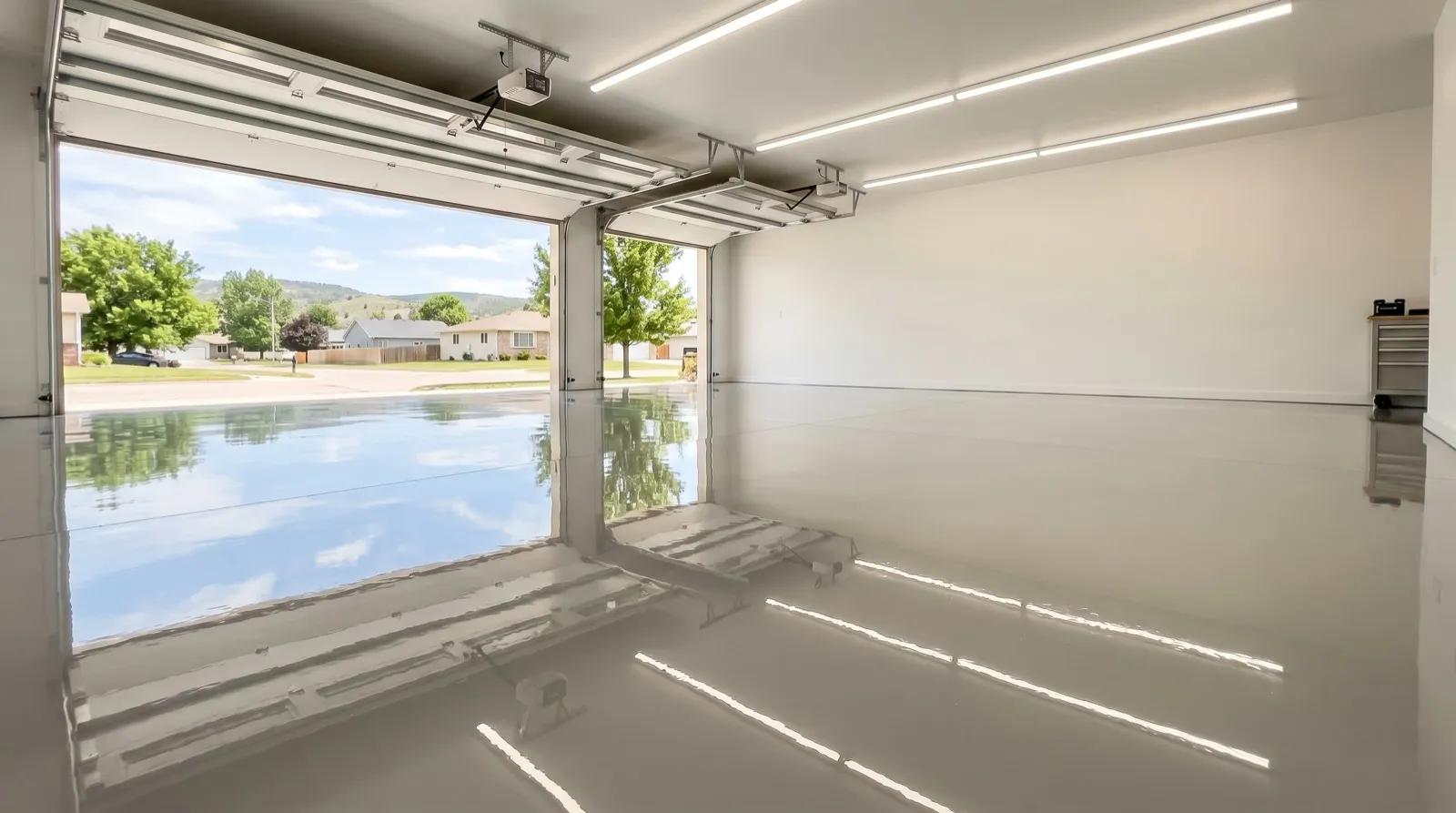
Polyaspartic is the better floor coating for a Rapid City garage. It cures chemically down to -30°F, stays flexible through the freeze-thaw cycle, and resists yellowing under direct sun. Standard epoxy needs a 50°F slab and full sun shielding to survive a Black Hills install. Here is the long version of why most local homeowners should pay the upgrade.
The short answer
If your garage sits anywhere from Rapid City to Sturgis to Spearfish, the coating has to handle a slab that swings from -20°F in January to 95°F in July, plus calcium chloride de-icer dripping off your tires from October through April. Two resin systems can do that job: epoxy and polyaspartic. They are not interchangeable.
Epoxy is older chemistry, cheaper material cost, and slower cure. Polyaspartic is newer, faster, more flexible, and roughly 30 to 50% more expensive. For our climate, the trade-off almost always lands on the polyaspartic side.
Side-by-side: what actually matters in the Black Hills
| Feature | Standard Epoxy | Polyaspartic | | --- | --- | --- | | Cure temperature floor | 50°F slab and air | -30°F | | Install window | Roughly May through September | Year-round, including January | | Full install time | 2 to 3 days | 1 day, start to finish | | UV stability | Yellows over time near sun-facing doors | Fully UV-stable, never yellows | | Flexibility (freeze-thaw) | Brittle below freezing | Stays flexible at -20°F | | Hot tire pickup risk | Possible if installed thin | Effectively zero | | Salt and calcium chloride resistance | Good | Excellent | | Warranty (our shop) | 10 years | 15 years | | Typical 2-car garage cost | $1,800 to $3,500 | $2,800 to $4,500 |
Why cold-weather chemistry matters here
A Black Hills slab moves. Concrete expands and contracts roughly 0.0000055 inches per inch per degree Fahrenheit. On a 24-foot wide garage with a 100-degree annual temperature swing, that is more than an eighth of an inch of seasonal movement. Epoxy is rigid. Polyaspartic flexes. Over a 10-year window, the flex difference is the difference between a fine network of hairline cracks telegraphing through your topcoat and a floor that still looks new.
The cure temperature question is even more practical. We get calls every January from Box Elder military families on a tight PCS timeline who need a garage done in three weeks. With epoxy, that is a no. With polyaspartic, we are on the schedule next Tuesday.
When epoxy is still the right answer
There are jobs where the math flips toward standard epoxy:
- The garage is unheated, you only park there in summer, and you are not coating until June anyway.
- You are doing a basic 2-car residential install on a very tight budget, and you accept a 10-year horizon instead of 15.
- The slab is in nearly perfect condition with no moisture issues and no spalling, so prep cost is minimal.
- You want a flake floor (epoxy and polyaspartic both support flake equally well) and you are not particularly worried about cold-weather installs.
For commercial work, the answer is almost always a hybrid: epoxy build-out coats for thickness, polyaspartic topcoat for chemical and UV resistance. See our commercial epoxy guide for the full breakdown.
The Rapid City climate context
The Black Hills region sees roughly 120 freeze-thaw days per year. That is more than Denver, more than Minneapolis, and roughly double what coastal cities see. Add the calcium chloride that Pennington County and Meade County crews lay down on every major street between November and April, and you have one of the harshest residential floor environments in the country.
We have polyaspartic floors installed in Black Hawk, Summerset, Piedmont, and Belle Fourche that have survived five full winters without a single hairline crack. We have epoxy floors from the same era that have needed touch-up work on the seasonal control joints. Both still look good. The polyaspartic floors look new.
Prep is non-negotiable for either system
Whichever coating you pick, prep is what decides whether you get 3 years or 15 years out of it. We diamond-grind every slab to a CSP-3 profile, structurally fill every crack with polyurea, and run a moisture test before any resin goes down. Our companion guide on why most DIY garage floors fail within 18 months walks through what good prep actually looks like and why acid etching is the single biggest reason consumer kits fail in this climate.
What we recommend in 90% of Rapid City cases
For a residential 2-car or 3-car garage anywhere in the Rapid City metro, the recommendation is polyaspartic with broadcast color flake. One-day install, year-round availability, 15-year warranty, harder and more flexible than epoxy, fully UV-stable. The roughly $1,000 upcharge over standard epoxy pays for itself in install convenience alone, before you even count the longer warranty window.
For commercial work, the answer is the hybrid build-out described above. For homeowners on a very tight budget who only need a summer-install entry-level floor, standard epoxy still has a place.
Get a free quote for your slab
We provide flat written quotes within 24 hours of an on-site visit anywhere in Rapid City, Box Elder, Black Hawk, Piedmont, Summerset, Sturgis, Spearfish, and the rest of the Black Hills service area. Slab condition, square footage, and finish choice are the three biggest cost variables. Call us at (605) 555-0100 or request a quote online.